One of the biggest misconceptions among small business owners is that invoice factoring is difficult to qualify for or reserved only for large companies. In reality, factoring is often one of the most accessible forms of business financing available, especially for growing businesses that sell to other businesses and experience slow-paying customers. Understanding the basic qualification requirements can help you determine quickly whether factoring is a good fit for your company.
Unlike traditional bank loans, factoring approval is based far less on your company’s credit score and far more on the quality of your invoices and the credit strength of your customers. Because of this, many businesses that are turned down by banks qualify easily for factoring.
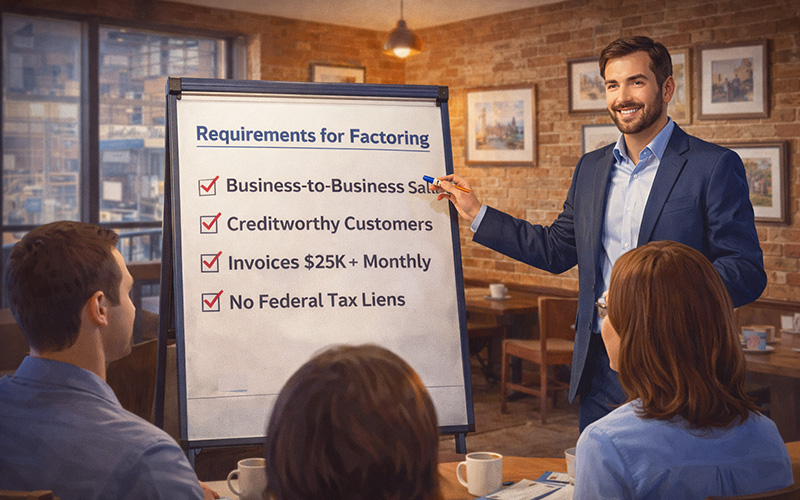
You Must Operate Business-to-Business (B2B)
The most fundamental requirement for invoice factoring is that your business sells to other businesses, not directly to consumers. Factoring companies purchase invoices, and those invoices must be owed by creditworthy commercial customers.
For example, a contractor billing a general contractor, a staffing company billing corporate clients, or a manufacturer invoicing distributors would all be strong candidates. A company selling only to individual consumers (B2C), however, generally does not qualify because consumer invoices cannot be factored.
Your Customers Must Be Creditworthy
Because a factoring company is advancing funds against your invoices, the factor focuses heavily on your customer’s ability to pay, not just yours. If your customers have a history of paying invoices reliably and on time, your business is far more likely to qualify.
This is why factoring approval rates are so high compared to traditional financing. Even newer businesses or owners with challenged credit can often qualify if their customers are financially strong.
Minimum Monthly Invoice Volume Requirements
Most factoring companies require a minimum amount of invoices each month to make the relationship efficient. While some factors may work with accounts as small as $10,000 per month, the majority prefer businesses billing $25,000 or more in monthly invoices.
That said, exceptions are often made for high-growth businesses, seasonal companies, or firms that are rapidly increasing their sales. If your business is close to these thresholds or trending upward, factoring may still be an option.
The Factor Must Be the Senior Lienholder on Invoices
Factoring is not a loan—it is the purchase of your accounts receivable. Because of this, the factoring company must be in first position on your invoices. This means there cannot be another lender already claiming your receivables as collateral.
If your business currently has a bank line of credit or loan secured by accounts receivable, it does not necessarily disqualify you, but it will require coordination or payoff of that lien before factoring can be established.
No Federal Tax Liens
Most factoring companies require that your business be free of federal tax liens. IRS liens take priority over all other claims, including factoring arrangements, and can prevent a factor from safely advancing funds.
If your business has unresolved federal tax liens, they typically must be satisfied or released before factoring can be approved. State tax liens may be acceptable in certain situations, depending on size and structure.
Invoices Must Be Valid and Current
Factoring companies only purchase completed, delivered, and billable invoices. Invoices must represent work already performed or goods already delivered, and they must be current—not past due.
Progress billing, milestone billing, or long-term contracts may still qualify, depending on structure, but speculative or unearned invoices do not.
A Simple and Practical Approval Process
Compared to traditional lending, the factoring approval process is fast and straightforward. Most decisions can be made in days—not weeks—and funding often follows immediately after setup. There are no long-term commitments required in many cases, and factoring grows naturally alongside your sales.
Is Factoring Right for Your Business?
If your business sells to other businesses, issues invoices, and is impacted by slow customer payments, factoring may be one of the most practical and flexible financing tools available. It converts your receivables into working capital, improves cash flow, and allows you to focus on growth—not collections.
At FactorUSA, we work with hundreds of factoring partners nationwide to help small businesses find solutions that fit their size, industry, and growth goals. Completing a simple inquiry can quickly determine whether factoring is right for you—and what options are available.